
A conversation on storytelling and leadership with Kirin Vicenti-Lacapa, tribal water commissioner and musician from the Jicarilla Apache Nation
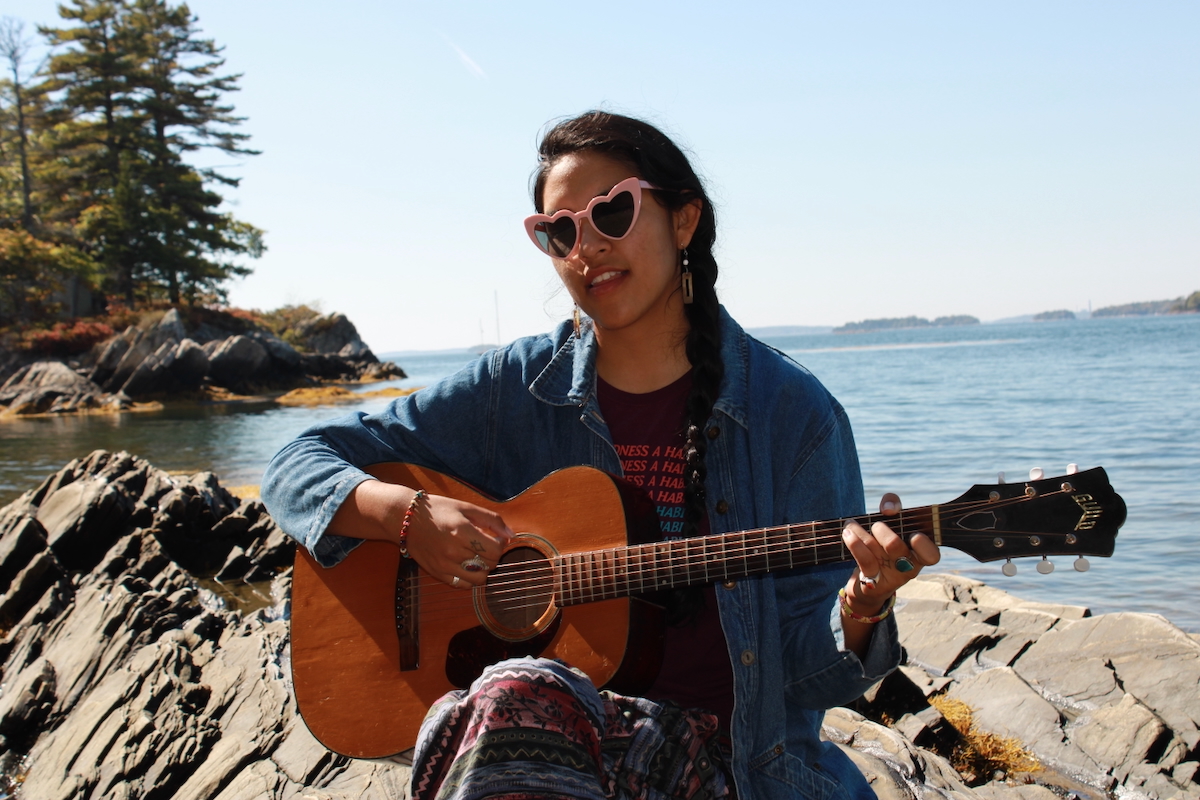
Above: Kirin Vicenti-Lacapa believes that art and music hold great power. “Art changes culture, culture changes people, and people change the world,” Vicenti-Lacapa shared during the podcast. Photo credit: Sage Lacapa.
In Episode 2 of the Listening to the Ripples podcast, we spoke with emerging leader Kirin Vicenti-Lacapa (Jicarilla Apache) about her work advocating for water sovereignty.
Vicenti-Lacapa is a musician, water commissioner for the Jicarilla Apache Nation, and an inaugural member of the Colorado River Indigenous Youth Advisory Council. She has served on the 2025 Colorado River Water Users Association Program Committee for the Ten Tribes Partnership and is a 2026 Northern New Mexico Climate Justice Leader.
As a water commissioner, Vicenti-Lacapa serves as a spokesperson for her tribe and also communicates updates back to them. In this role, she draws from her experience as a performing musician and storyteller to deliver updates with stage presence and confidence. Vicenti-Lacapa has spoken at several conferences, including the Colorado River Water Users Association, World Water Week in Sweden, and the Native American Fish and Wildlife Service Southwest Region.
Listen to podcast episode 2 here:
Read the transcript here: Read transcript. Listen and Subscribe on Apple Podcast.
IN THIS EPISODE
During Episode 2, Kirin Vicenti-Lacapa and podcast host tylee nez discuss a number of documents, legal decisions, and concepts that might be new to listeners. More information on some of these items is below.
THE GUIDING DOCUMENT: WHAT IS THE COLORADO RIVER COMPACT
The Colorado River Compact of 1922 created the framework for water allocation by dividing the Colorado River basin into two parts: the Upper Basin (Wyoming, Utah, Colorado, New Mexico) and the Lower Basin (Arizona, Nevada, California). The Compact initiated a series of acts, decrees, court decisions, and treaties to further outline water allocation and secure water rights for states and industries.
However, the Compact did not include any tribal nations, and this continues to be the case today.
“Even though [the Colorado River Compact of 1922] was over 100 years ago until today, where tribes do not have not only equal say. They don’t have really any say in tribal water… That’s really a problem,” Vicenti-Lacapa explained in the podcast.
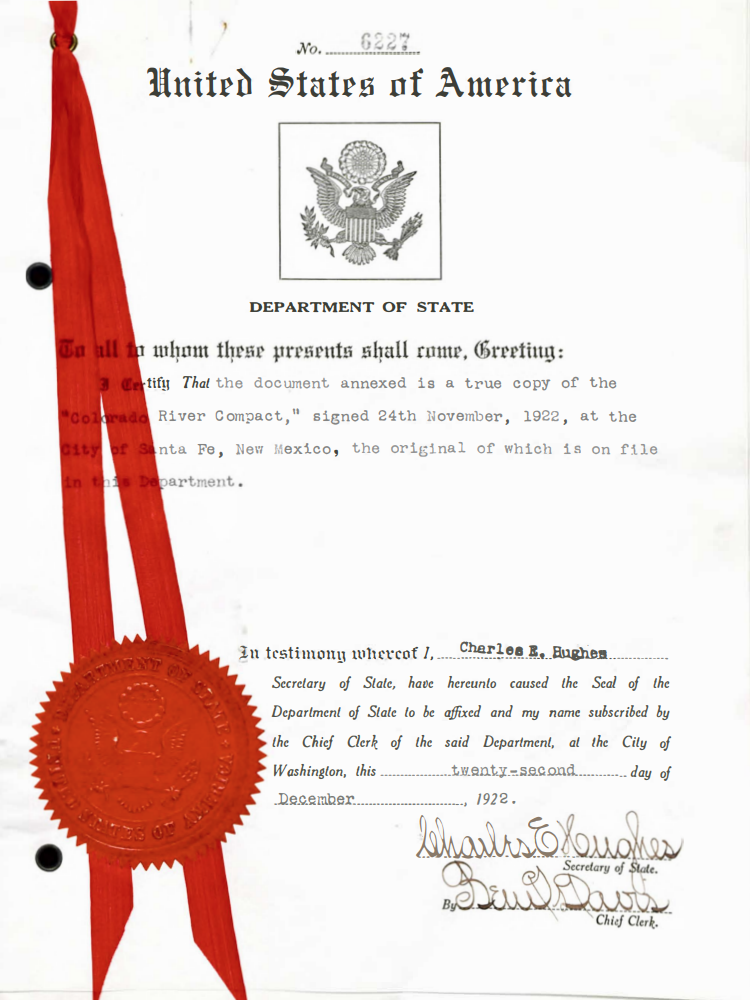
The Compact was formed during a particularly wet time period in the Colorado River Basin, with future allocations made based on this uniquely wet hydrologic cycle — levels of water that the river has not consistently been able to meet in subsequent years.
Now with warming temperatures, severe drought, and increased demand for water, the Colorado River is rapidly shrinking.
Today, in response to water management challenges and expired guidelines in the Colorado River Basin, water managers are renegotiating certain key operating guidelines and water agreements. In the current negotiations, as Vicenti-Lacapa explains in the podcast, there is a common misconception that all tribal nations are the same. The current system treats tribal nations as if one solution fits all, ignoring that each nation has distinct needs, knowledge, and priorities tied to their place and cultural values.
A tribal nation whose reservation boundary is near the headwaters will have drastically different needs compared to a downstream reservation in the Sonoran Desert, for example.
“There is [tribal] consultation, but there’s not collaboration,” Vicenti-Lacapa said. “And when you have consultation without action, then you’re just checking a box and saying that you did this thing where you listened to the tribes and their concerns. But if you don’t have the action that comes with it, then it’s checking a box.”
Ultimately, this approach neglects and diminishes tribal sovereignty and knowledge rather than respecting and engaging it.
COMMUNITY EDUCATION
Within their role as water commissioner, Vicenti-Lacapa often shares knowledge with their community, which requires leaving out technical jargon, acronyms, and complex policy. This is something Vicenti-Lacapa actively thinks about when communicating information back to her tribe, because this was a barrier Vicenti-Lacapa faced in the beginning of this role.
“It’s important to leave all the jargon out of it, because when I first went to the Colorado River conferences, I was overwhelmed with jargon, acronyms, and things that I did not quite understand yet. And that was a barrier of entry for me to be able to have a conversation with somebody who has worked in the Colorado River basin for 20-plus years,” Vicenti-Lacapa said.
Vicenti-Lacapa explained that one way to understand the limitations of tribal water rights in the Colorado River is by what is known as the Four U’s of Tribal Water Rights: unused, undeveloped, unquantified and uncompensated tribal water.
- Unused: Water rights exist but are not used due to a lack of infrastructure and money.
- Uncompensated: Water rights have been settled, but water is used to satisfy legal obligations, resulting in uncompensated benefits to leaser.
- Unquantified: Inherent rights to water exist, but have not been legally settled or measured.
- Undeveloped: Water rights have been settled, but are unable to be used due to lack of infrastructure.
These Four U’s are important because they affect and are affected by tribal sovereignty, economic opportunity, and water security in the Basin.
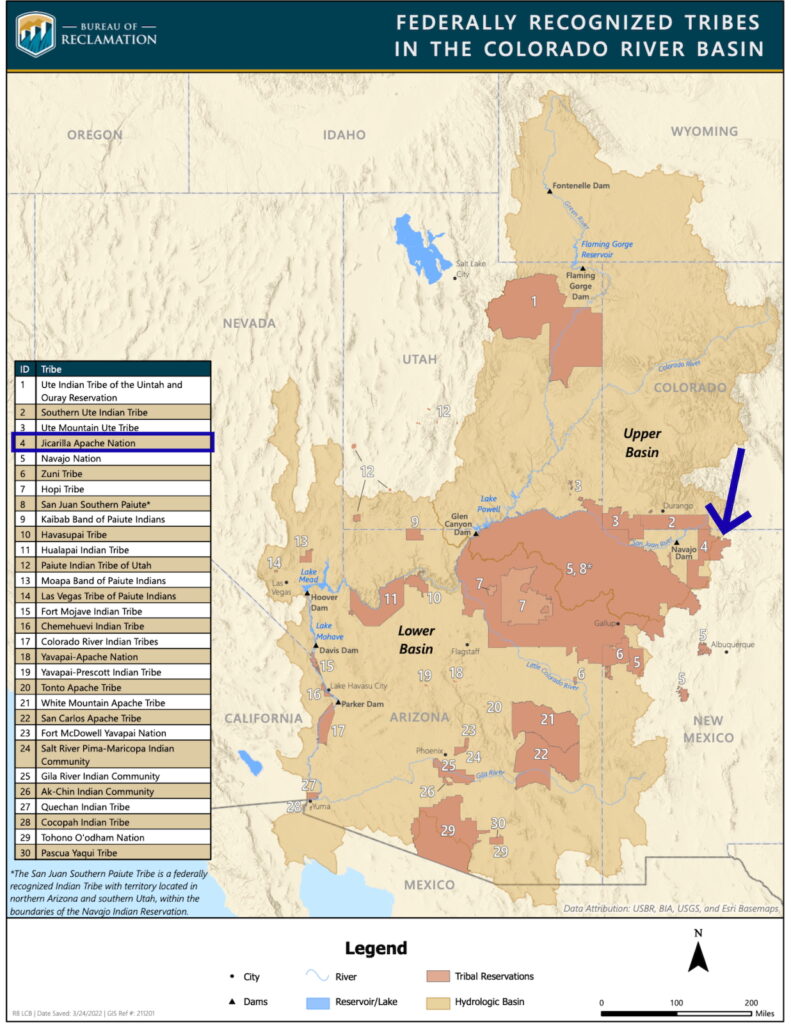
Out of the 30 Federally Recognized Tribes in the basin, 22 tribal nations hold quantified water rights, accounting for approximately 25 percent of the Colorado River’s flows on paper—much of this water goes unused because of funding and infrastructure. Eight tribal nations (Havasupai Tribe, Hopi Tribe, Hualapai Tribe, Kaibab Band of Paiute Indians, Pascua Yaqui Tribe, San Juan Southern Paiute Tribe, Tonto Apache Tribe, and Yavapai-Apache Nation have unquantified rights, and four are partially resolved (Fort McDowell Yavapai Nation, Navajo Nation, Pueblo Zuni, San Carlos Apache Tribe). Once settled, tribal water allocation will increase
INDIGENOUS MATRIARCHS LEADING
Vicenti-Lacapa addresses the importance of respecting and supporting Indigenous matriarchs as prominent leaders, organizers, and advocates.
“Our matriarchs are the ones who keep the relations, keep the knowledge of the relations, not only within the family but these are where our families are from, and this is what we’ve done, and this is how we’ve tended to the land, or this is how we’ve existed. And I think that knowledge, and that respect, doesn’t just go away, and it doesn’t just stay stagnant in our bodies. It comes through as resilience and with action behind,” Vicenti-Lacapa shares.
“The respect and love that [Indigenous matriarchs] have for place is — it’s not something to be disregarded… We are there. We’re showing up.”
It is essential to the flow of the river that Indigenous matriarchs in the basin are respected. They are the caretakers of the land and water.
A REMINDER IN THE FIGHT FOR WATER
At the end of the episode, Vicenti-Lacapa reminds listeners that even though water negotiations and water rights issues sometimes feel endless and discouraging, the day-by-day efforts of each person matter – just as each drop of water over thousands of years has helped form the river and canyons that we see today.
“… water it takes time. The Grand Canyon wasn’t carved in a day, wasn’t carved in a week, it wasn’t also carved with a drop. It’s rushing,” said Vicenti-Lacapa. “[Your efforts] still have an impact, no matter how small of a drop you think you’re dropping into the river or if you feel like you are pouring your whole body, and your whole heart, and soul into this work, it’s not lost. I applaud you for fighting the good fight …”
Sustaining the life-giving river lies in collective collaboration, not solely on a single person or institution. Failure to recognize the inherent right of tribal nations to the water, managing the river without authentic collaboration, and the role Indigenous matriarchs play in the future of the flow, puts all living in the basin and all that rely on the water at risk.
MORE INFORMATION
To stay up to date with Vicenti-Lacapa’s work and concerts, follow on Instagram @Kirilacavici
See Kirin Vicenti-Lacapa Tribal update for CRUWA’s Upper Colorado River Commission – CRIYAC Member at UCRC
Read more about Vicenti-Lacapa’s work – N.M. must make crucial water investments
To learn more about the Jicarilla Apache Nation within in the Colorado River Basin, please visit: Ten Tribes Partnership – Jicarilla Apache Nation
tylee nez is water protector, storyteller, youth leader, and artist from the high deserts of the Navajo and Hopi lands, within Lower Colorado River Basin. tylee is a founding member of the Colorado River Indigenous Youth Advisory Council (CRIYAC), 2026 Young Climate Leader of Color (YCLC) Fellow, member of Indigenous Women’s Leadership Network (IWLN), and holds a B.S. in Environmental Engineering from Tufts University.