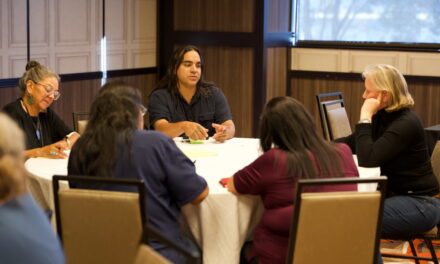

Last month, two members of the Native Resilience project’s Resilience Reporter program attended the 2025 Indigenous Media Conference (IMC) in Albuquerque, New Mexico. This three-day conference, hosted by the Indigenous Journalists Association, featured sessions on Indigenous environmental justice, climate change storytelling through Indigenous perspectives, climate visual storytelling, and many other topics of interest to reporters Mary Cathleen Wilson and tylee nez.
The 2025 IMC conference provided a meaningful opportunity for Wilson and nez to connect with a broad network of other Indigenous journalists, meet editors, share their work, and learn from others who are covering Indigenous environmental justice and climate change. After the conference, we invited Wilson and nez to reflect on their experiences – to highlight a session that inspired them, or something they will carry into their future work. Read on to explore their insights and takeaways!

Indigenous Media Conference 2025 Reflection
By tylee nez, Resilience Reporter
As the week of the Indigenous Media Conference began, journalists from diverse backgrounds across the globe gathered in Albuquerque, New Mexico. On the other side of the world, five journalists were murdered, targeted in Gaza, Palestine, outside of their media tent near the hospital. This story weighed on me as I traveled to Pueblo territory, as I put on my moccasins every day, as I entered the conference venue, navigated my way to each session, ate lunch, and as I lay in bed resting for the next day
I expected some type of acknowledgment, since this conference was about journalists and 2024 was the deadliest year for those in this profession, according to a report by the Committee to Protect Journalists – but the acknowledgement never came. This was constantly on my mind for every day of the conference, and even afterwards. It was the foundation of this reflection, as depressing as it sounds. I am reminded that Indigenous journalists are not guaranteed safety and security, especially those reporting on violence to the earth and communities derived from the ripples of climate change, greed for abundant resources, and power.

With this story looming in my thoughts, I began the first day of the conference. Standing in line for breakfast, I made my first connection — the start of many connections to come. The first question I would be asked was “Are you a journalist?” or “Which outlet are you with?” My eyes widened, trying to figure out what I should say. It did not feel right to say “yes” because I am so new to it. So, I would say “I am an aspiring journalist/reporter,” followed by a quick explanation of the Native Resilience Reporter program.
I have attended many conferences this past year, and this one was by far the most welcoming. Every person I talked to was super supportive and even encouraged me to contact them for guidance or mentorship. After each day, I felt so incredibly blessed by the many connections and to be sharing space with extremely talented storytellers. After every connection I made, I wrote their names in my notebook, along with a quick bullet point about their work to help my memory when I look back to reach out. Three weeks later, I can say this was a very smart thing to do.
Beforehand, I reviewed the agenda to highlight the sessions I was interested in, which mostly were about communicating climate stories through visual and audio storytelling. This is an area I am interested in and want to gain more knowledge. After attending the “Visual Storytelling with Indigenous Communities” session, it was evident that visual storytelling is an essential skill to have as a journalist. The session was comprised of four panelists; it was so moving to view all their works and it inspired me to be creative in capturing and creating visuals.
Out of all of the sessions, the most memorable and intriguing stories and visuals were from the journalists with unique journeys, because they were able to bring their previous works and experiences into storytelling. This is reassuring to me because I am following an unusual pathway into journalism, having studied engineering in college. But as many amazing, talented journalists told me, that is my superpower: being able to understand and communicate the technical side is crucial, this is a powerful bridge.
Leaving this conference, I felt so inspired and driven to do the work that calls my heart, which is about sharing and uplifting Indigenous voices in a respectful, culturally appropriate way. I am writing more often — writing about the stories I hear, writing about my experiences (past ones too), writing about my hopes, visions, and have even dusted off my camera to capture what I see. I feel so honored and blessed to have shared space with everyone who attended and for the opportunity to connect with a strong network of remarkable storytellers so early in life.
Solutions Journalism Network Is Building Hope With Teeth
By Mary Cathleen Wilson, Resilience Reporter
Solutions journalism to me is about reminding myself and others that even though a lot of the news focuses on the cracks in the pavement, there’s a whole world out there teeming with possibilities, that inspires hope and reminds us of our humanness.
–Sonal Gupta, Train-the-Trainers participant, 2023 SJN Annual Report
Journalism offers more than warning signals; it can serve as a guiding tool, according to the Climate Visual Storytelling: Skills for Amplifying Indigenous Narratives panel discussion at the Indigenous Media Conference in Albuquerque, NM. This presentation was organized by the Solutions Journalism Network’s (SJN) Climate Beacon Newsroom Initiative (CBNI), which provides training in how journalists and newsrooms can better cover climate change by highlighting and exploring solutions within their communities.

In this session, four journalists from the Osage News and the Cherokee Phoenix who have participated in CBNI’s training provided an in-depth look at how they utilized this new solutions-based reporting skillset to cover an environmental justice story reported by the Cherokee Phoenix highlighting Cherokee water protectors and sustainable poultry farming.
Climate doom fatigue affects numerous people in our society. CBNI takes a hope-with-teeth approach to storytelling, delivering evidence-based climate response stories that reveal solutions and reasons to be hopeful instead of only presenting despair scenarios to audiences. For Indigenous communities who need practical solutions for land and water protection, along with air and health defense, solutions journalism offers a framework for sharing ideas about what is working and what isn’t.
The CBNI program was initiated in 2023 with nine US newsrooms and asked participants to shift their efforts away from doom-and-gloom-style climate reporting and move toward sharing climate solutions. In 2024, CBNI established five new visual storytelling newsrooms dedicated to climate solutions, and it now plans to continue this partnership with the Indigenous Journalists Association (IJA) to expand the model throughout Indian Country during 2026. The initiative holds significance for under-resourced and vulnerable tribal communities, providing Indigenous communities with storytelling tools that build resilience and help shape culturally appropriate climate solutions
The four pillars of solutions reporting: What’s missing from the conversation?
The Solutions Journalism Network promotes an approach to reporting that incorporates what they refer to as the “four pillars.” After identifying an issue or question of concern (e.g. Climate change, public safety, low graduation rates), the journalist should consider:
- Response – What’s being done. “Focuses on a response to a social problem – and on how that response has worked, or why it hasn’t.”
- Insight – What others can adapt. “Shows what can be learned from a response and why it matters to a newsroom’s audience.”
- Evidence – How we know if a response is working or not. “Provides data or qualitative results that indicate effectiveness (or a lack thereof).”
- Limitations – What’s unknown or constrained (real-world boundaries or tradeoffs that determine the effectiveness of a response for specific groups of people. “Places responses in context; doesn’t shy away from revealing shortcomings.”

It’s catching on: Examples shared at IMC
In this session, the SJN/Cherokee Phoenix reporting team described how they collaborated to report on high-impact unsustainable poultry farming. The Cherokee Phoenix conducted a two-part series called Protectors: Homestead and mid-size chicken farms to present the stories of water protectors and chicken farmers who work together to maintain clean water and land while exposing the commercial poultry industry’s destructive water source dead zones (eutrophication) created by dumping high volumes of chicken manure on lands. After the rains, high volumes of animal waste like poultry manure eventually drain into rivers or lakes. The toxic amounts cause algae to grow too fast, and as the algae dies, it uses up the oxygen in the water, which can choke out fish and other animals. The local commercial poultry industry fails to recognize the essential practices that the Cherokee water protectors and farmers emphasize.
The second part of the series, Protectors: Spring Creek, features Cherokee-owned Longshadows Ranch and Prairie Creek Farms, which operate under non-Native management. The two farms operate chicken-raising systems that differ from conventional large-scale poultry operations. The operators at Longshadows Ranch and Prairie Creek Farms work to maintain sustainable chicken production methods that benefit both the environment and respect for animal well-being.
Panel members noted that the editor had to be involved earlier in the reporting process as the reporting shifted from a problem focus to a solutions focus. According to the reporting group, the shift increased their skill set. They went straight to the community, as “it was in their own backyard!” and met with community members to build trust. Questions arose among the reporting team, such as, “How do we co-plan the reporting?” Photographers and journalists had to leave their egos at home as both worked actively reporting together. Having visuals first helped talk them through the story. What followed was brainstorming by everyone on the story content, which was “more efficient than going out blind,” and “It was no longer just writing the facts and that’s it!”
My takeaway:
Journalism is environmental justice, which means that truthful reporting, open records, and independent accountability are not extras, but the fundamental infrastructure tribal communities need to protect land, water, air, and health and to exercise sovereignty. Tribal communities need independent newsrooms and open meeting laws. Good reporting gives people the facts to defend our homelands and make fair decisions. The Cherokee Phoenix pollution stories showed how journalism can support environmental justice by helping communities meet challenges with clarity and clear solution-focused instructions for remediation.
About the Resilience Reporter program
The Native Resilience project’s Resilience Reporter internship program aims to build awareness nationally about resilience initiatives on Indigenous lands, and build communication, journalism, and multimedia storytelling skills useful to interns as they move forward in their careers. Reporters practice telling stories using photography, audio, video, writing, artwork, poetry, and/or other creative medium of their choice. You can read samples of their work here: Resilience Stories | Native Resilience.